发布时间:2026-04-28 09:39:20 浏览量:
Rotary evaporator is a commonly used equipment in laboratories, consisting of a motor, distillation flask, heating pot, condenser tube, etc. It is mainly used for continuous distillation of volatile solvents under reduced pressure conditions and is applied in fields such as chemistry, chemical engineering, biomedicine, etc.
1、 Structural principle
A distillation flask is an eggplant shaped or round bottom flask with a standard ground mouth interface, connected to a pressure reducing pump through a highly reflux serpentine condenser tube. The other opening of the reflux condenser tube is connected to a receiving flask with a ground mouth, used to receive the evaporated organic solvent.
There is a three-way piston between the condenser tube and the pressure reducing pump. When the system is connected to the atmosphere, the distillation flask and the liquid receiving flask can be removed to transfer the solvent. When the system is connected to the pressure reducing pump, it should be in a reduced pressure state. As a heat source for distillation, it is often equipped with a corresponding constant temperature water bath.
2、 Purchasing Tips
Before choosing a rotary evaporator, it is important to clarify some questions, such as: What is the amount of distillation per cycle? How many samples need to be distilled per day? What are the expected solvents for distillation? What is the approximate boiling point range of solvents? Are these solvents flammable, explosive, toxic, or harmful After clarifying the above issues and determining the experimental requirements and solvent type for distillation, you can start purchasing a rotary evaporator.
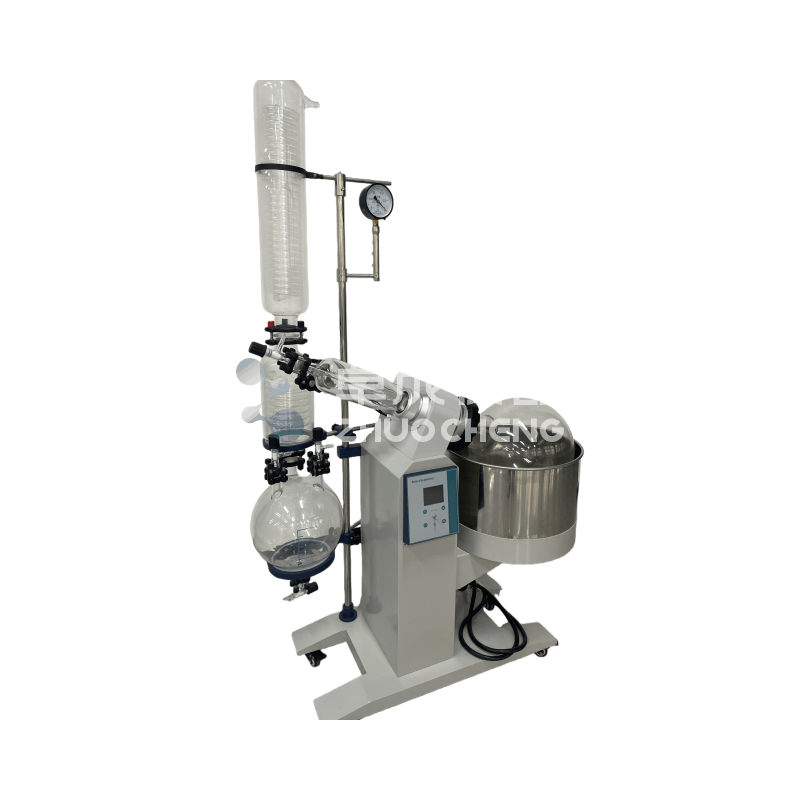
1. Clarify the specifications of the rotary evaporator
The specifications of a rotary evaporator are usually distinguished by the volume of the evaporator bottle. The size of the required evaporator bottle depends on the amount of material being evaporated. Generally speaking, 2L, 3L, and 5L rotary evaporators are suitable for small-scale laboratory experiments; 5L, 10L, and 20L are suitable for pilot testing; 20L and 50L are suitable for pilot testing and production. Lichen rotary evaporator has multiple specifications and models ranging from 4.5L to 10.4L, providing rich choices for different experimental needs in the laboratory. In special circumstances, continuous feeding tubes can also be used to expand the volume of the evaporator bottle, thereby increasing the continuous distillation volume to a certain extent.
2. Clarify the distillation tasks that the rotary evaporator needs to complete
① Distillation efficiency
The distillation efficiency of a rotary evaporator determines the number of samples that can be distilled per day. Under the same solvent conditions, the higher the distillation efficiency, the more samples can be distilled. If the sample size is large, when choosing a rotary evaporator, more consideration needs to be given to distillation efficiency.
② Security risk assessment
The safety risks of distillation mainly come from the solvents and heating media used in distillation. If the heating medium is silicone oil, the ignition point should be at least 25 ° C higher than the maximum temperature of the heating pot. If the distilled solvent has flammable and explosive properties, explosion-proof glass components can be used as the first choice. After the distillation is completed, it is best if the instrument can automatically release gas to avoid manual release of gas too quickly, which may cause an explosion. Optimize the laboratory environment by selecting a secondary condensation device to maximize the recovery of distillation solvents.

 微信公众号

 官方抖音账号
郑州卓成仪器科技有限公司
Copyright © 2020-2024 豫ICP备16023668号-1


